
 3:35
Four-bar linkage step by step
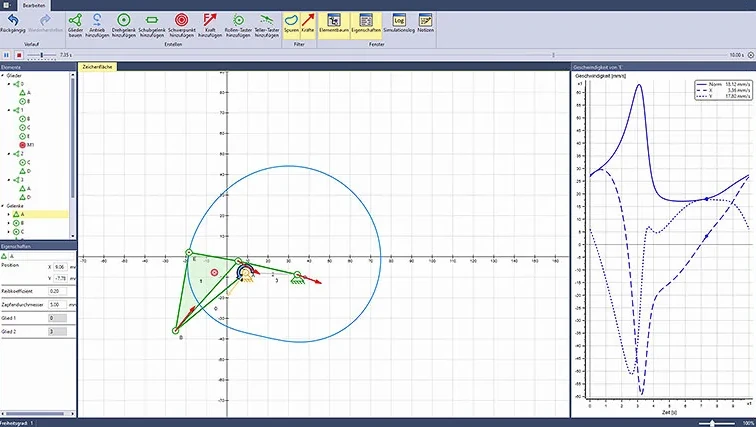
From a blank sheet to a rotatable four-bar linkage with bearing forces and friction – the whole process in ASOMmini.
The four-bar linkage is the simplest and most common linkage: four links, four revolute joints. You find it in hinges, flaps, seat adjusters and windshield wipers. Here you can read which types exist, what matters in the design and how ASOM and ASOMmini support you.
3:35A four-bar linkage consists of the frame, two links pivoted on the frame and the coupler, which connects the two. When one link is driven, the motion of all the others is uniquely determined. Which motion results depends on the four lengths alone.
What a four-bar linkage is used forDepending on which link is the shortest and how the lengths relate to each other, a link turns fully or only rocks. The Grashof condition tells you whether any link can turn fully at all.
The input link turns fully, the output link rocks back and forth. The most common type when a motor is to produce a rocking motion. See the example
The frame is the shortest link: input and output both turn fully, the output non-uniformly. See the example
Both links pivoted on the frame only rock. Typical of hinges and flaps with a limited opening angle. See the example
Turquoise: the shortest link in each case. Dotted: the paths of the joints.
Move the joints with your mouse or finger: as the lengths change, so does the type. Coupler curve, transmission angle and diagram are recalculated with every movement.
Drag A₀, B₀, A, B or K
Whether a four-bar linkage works in practice is decided by the conditions of the application. They change frequently during a project, and every change affects everything else.
You move a joint and immediately see the complete motion sequence including forces and torques.
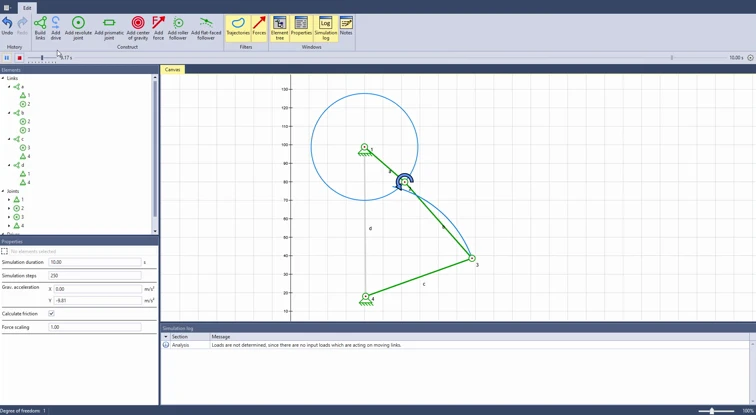
In ASOMmini, you connect links and joints into a chain and see trajectories, angles and diagrams in real time. About ASOMmini
ASOM generates the four-bar linkage by synthesis from specified points or positions and maintains the requirements while you optimize. About ASOM
Manual forces, drive forces and joint forces with friction appear alongside the motion, in ASOM for all scenarios at once.
3:35
From a blank sheet to a rotatable four-bar linkage with bearing forces and friction – the whole process in ASOMmini.
 1:17
Four-bar linkage series, part 1: the crank turns fully while the rocker swings. The Grashof condition and the choice of frame tell you when this is the case.
 1:21
Four-bar linkage series, part 3: if the Grashof condition is met and the frame is opposite the shortest link, both rockers swing and only the coupler turns fully.
A planar linkage of four links connected by four revolute joints. One link is the frame; when one of the others is driven, the motion of the rest is uniquely determined.
When the Grashof condition is met: the shortest and the longest link together are no longer than the other two together. Which link then turns fully depends on where the shortest link is located.
As a guideline, the minimum transmission angle should not fall below about 40°. Below that, the joint forces rise sharply and the linkage becomes stiff to move.
For setup, motion, forces and torques, yes. If the four-bar linkage is to be generated from specified points or positions or checked in many scenarios, ASOM is the right choice.
Yes. DXF drawings can be placed as a template or attached to a link so that they move with it.
Tell us about your application. In an online demo, we will show you ASOM or ASOMmini using your own example.