
 2:10
Tailgate with gas springs
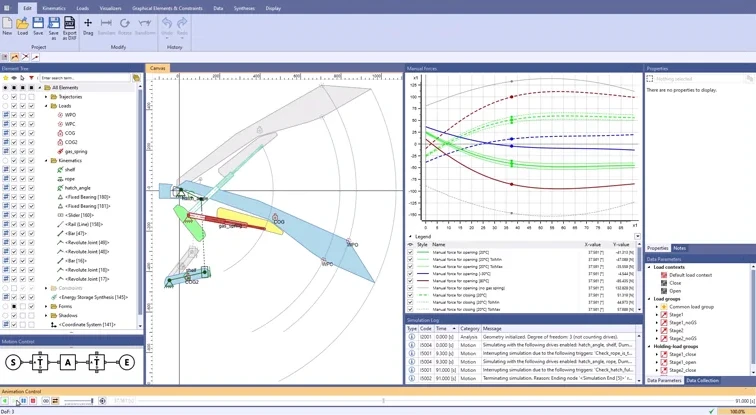
Two gas springs whose force depends on temperature and direction of motion, plus a parcel shelf on a cord. ASOM shows all manual forces for opening and closing in one diagram.
A flap should open easily, stay open and close in a controlled way – in summer and winter alike. This page explains what matters when designing gas springs and how ASOM supports you.
2:10
Tailgates, engine hoods, furniture flaps, lids, seats and beds: in all of them, gas springs counterbalance the weight of a component. Weight and spring act over the entire motion, each with a changing lever arm. Whether the flap is easy to operate therefore only becomes clear over the entire travel, not in a single position.
Inside the pressure tube, nitrogen is under pressure. On the piston rod side, the piston area is smaller by the cross-section of the rod, so the pressure pushes the rod out. The filling pressure determines how strongly.
The gas spring force acts through its lever arm about the pivot. If its line of action passes close to the pivot, it contributes little to counterbalancing. Just a few centimeters at the mounting point change the entire manual force curve.
Simplified calculation example with assumed values: tailgate 18 kg, extension force F1 of both gas springs 560 N combined at 20 °C, without friction or tolerances. The spring length is adapted to each mounting point. Without friction, the curve shows the force needed to hold the flap: opening takes a little more upward force, closing a little more downward force.
A rough calculation for the open position gives a first value for the spring force. In operation, further factors come into play, and only all of them together show whether the flap is easy to operate.
You move a mounting point, and ASOM immediately recalculates all forces and torques over the entire motion.
You define lengths, forces and the characteristic curve yourself. ASOM takes temperature, friction for each direction of motion and tolerances into account, including for temperature-compensated gas springs.
Opening and closing, summer and winter, vehicle on a slope: ASOM shows each scenario as a separate curve. More on force calculation
You specify which holding force should apply in which position. ASOM adjusts the force and lengths of the spring accordingly. You then use these values to check with your supplier whether the spring can be built this way. More on syntheses
2:10
Two gas springs whose force depends on temperature and direction of motion, plus a parcel shelf on a cord. ASOM shows all manual forces for opening and closing in one diagram.
 2:41
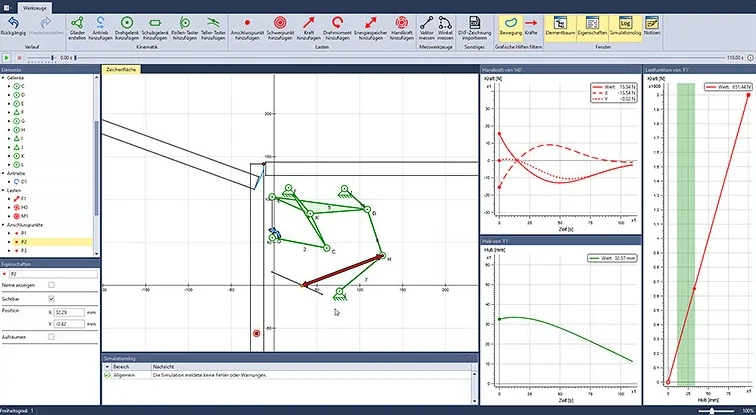
Set the tension springs on a six-bar hinge so that a 2–8 kg flap opens by itself from about 15–20°. ASOMmini shows the manual force curve, and you find the right attachment point in the model.
 1:40
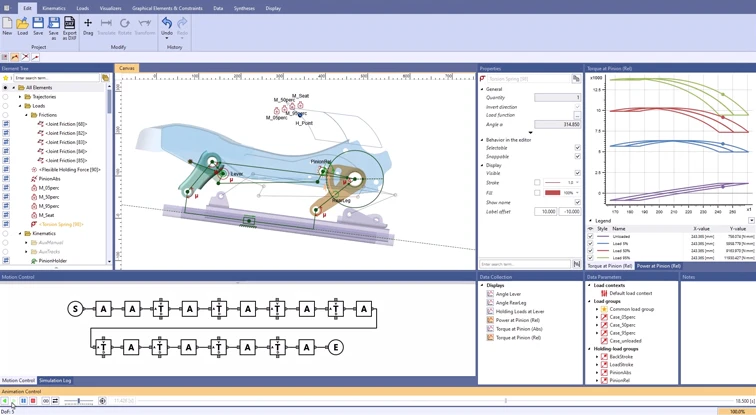
An electric motor moves the seat to all extreme positions. ASOM shows torque and power for different seat occupancies – and instantly reveals what difference a torsion spring makes.
Not from the weight alone. What matters is how weight and spring interact over the entire opening angle. ASOM calculates this for every position and every scenario.
No. In ASOM, you define which spring your mechanism needs: force, characteristic curve, lengths and stroke. You then use these values to ask your supplier whether the spring can be built this way. That way, the spring fits the flap – not the other way around.
In the cold, the gas pressure drops and with it the spring force. If the spring is designed only for 20 °C, the force may not be enough in winter to hold the flap open. In summer, on the other hand, the flap is hard to close. In ASOM, you see the manual forces for cold and heat in one diagram and can spot this as early as the design stage.
Wide flaps usually have two gas springs, left and right. The force is shared, and the flap is supported evenly. In ASOM, you calculate both springs together, including springs installed at an angle.
Yes. In addition to gas springs, ASOM handles tension, pressure and torsion springs, as well as friction and inertia. For simple flaps with springs, often all you need is ASOMmini, as the kitchen cabinet flap example shows.
Tell us about your mechanism. In an online demo, we will show you ASOM using your own example.