
 1:17
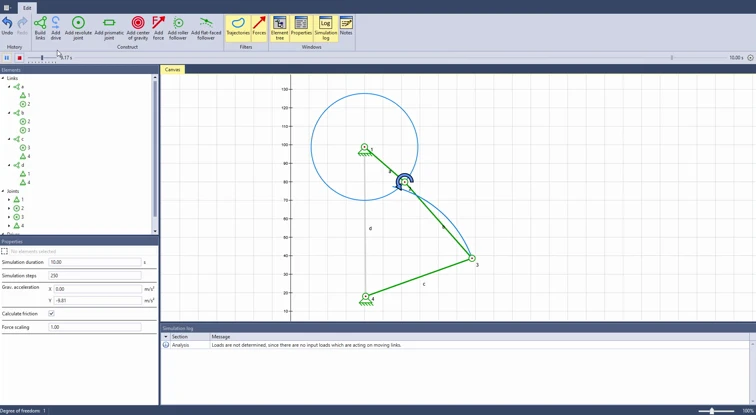
Crank-rocker
Four-bar linkage series, part 1: the crank turns fully while the rocker swings. The Grashof condition and the choice of frame tell you when this is the case.
Both links pivoted on the frame only swing back and forth – two rockers. Here, only the coupler turns fully.
 1:21
The Grashof condition is met here as well. The only difference from the crank-rocker and the double-crank is the choice of frame.
The frame is now c, the link opposite the shortest one. Because c cannot turn fully relative to b and d, b and d swing as rockers. The shortest link a becomes the coupler and turns fully relative to its neighbors. If the Grashof condition is not met, no link turns fully, not even the coupler: the linkage is then not rotatable – a non-Grashof or triple-rocker linkage. Whichever link is the frame, both links pivoted on the frame only swing back and forth.
In ASOMmini, you build every type in this series with just a few clicks and immediately see how it moves.
Move a joint, and ASOMmini recalculates the motion in real time – so you can see when a link no longer turns fully.
Trajectories show the paths of the joints, and diagrams show angles, velocities and accelerations over the entire motion sequence. More on analysis
With masses, springs and friction, the basic type becomes a concept – and ASOMmini calculates its forces and torques. More on force calculation
1:17
Four-bar linkage series, part 1: the crank turns fully while the rocker swings. The Grashof condition and the choice of frame tell you when this is the case.
 1:22
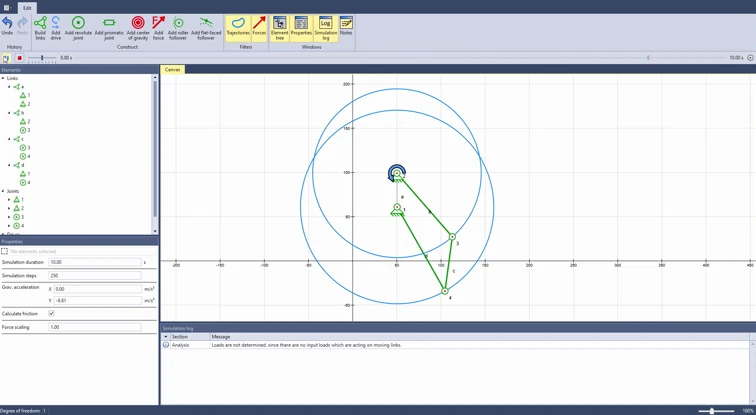
Four-bar linkage series, part 2: if the Grashof condition is met and the shortest link is the frame, both links pivoted on the frame turn fully.
 1:01
Four-bar linkage series, part 4: links of equal length are opposite each other, as a parallelogram or crossed – a limit case of the Grashof condition.
Tell us about your mechanism. In an online demo, we will show you ASOMmini using your own example.