
 2:29
Manually operated car seat
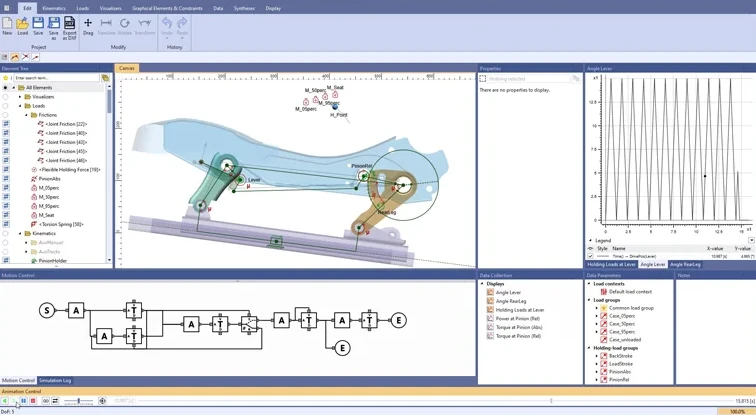
A hand lever adjusts the seat stroke by stroke. ASOMv10 plays back the strokes automatically and shows the manual force for different seat occupancies in one diagram.
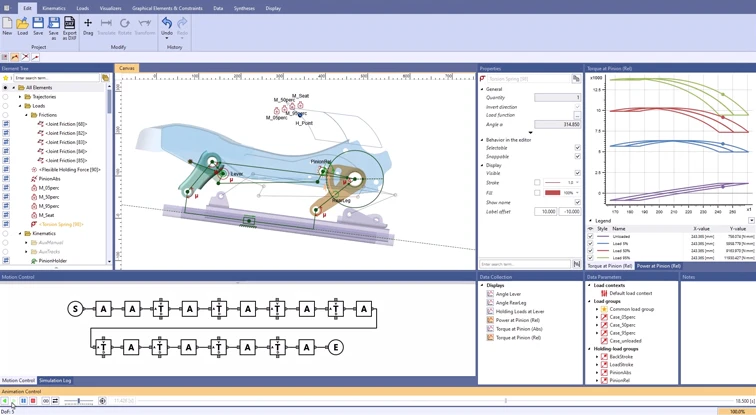
An electric motor adjusts a car seat. ASOMv10 shows the torque and power of the motor for different seat occupancies – and what difference a torsion spring makes.
 1:40
An electric motor drives the four-bar linkage via a gear pair and moves the seat through all extreme positions. The torque and power it needs depend on how the seat is occupied. The system also contains a torsion spring whose characteristic curve influences the required motor torque.
You see immediately how the spring and the seat occupancy change the motor torque, and you design the drive to match from the start.
You know the torque and power for every occupancy before the motor is selected. More on force calculation
You check whether the motor and spring match on the model instead of on the prototype.
One diagram per quantity with all load cases, instead of many individual calculations. More on diagrams
2:29
A hand lever adjusts the seat stroke by stroke. ASOMv10 plays back the strokes automatically and shows the manual force for different seat occupancies in one diagram.
 5:01
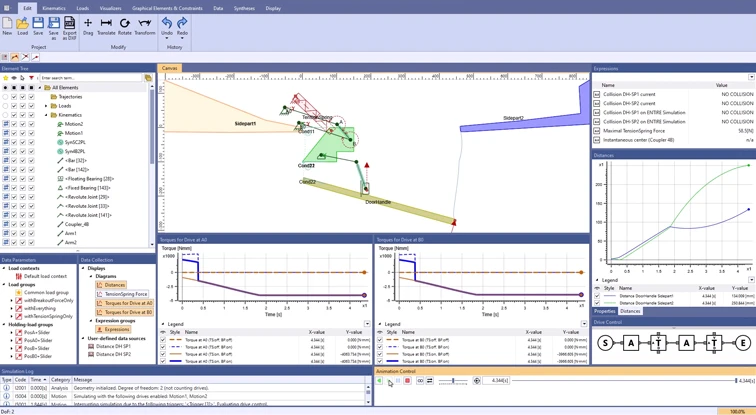
A retractable handle with three specified positions. Two syntheses hold them in place while you move bearings, and ASOMv10 calculates eight drive cases at once.
 3:13
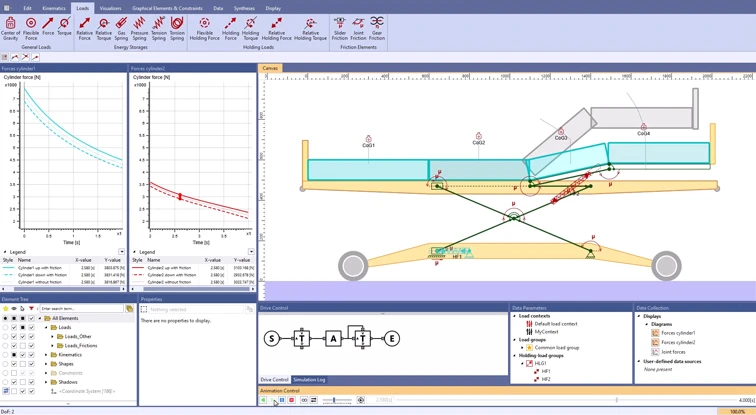
Two drives that model spindle drives adjust the height and the foot section. ASOMv10 calculates drive and bearing forces in real time, with friction in all joints and guides.
Describe your mechanism to us. In an online demo, we will show you ASOMv10 using your example.