
 2:29
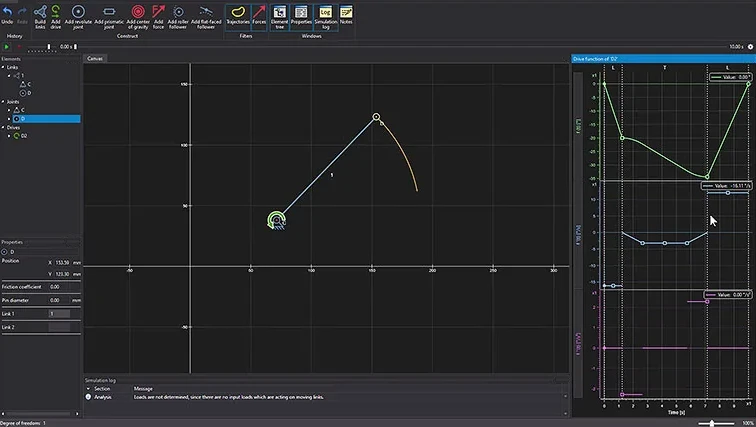
Drive functions
A rotating motion becomes an oscillating motion. You shape the motion profile directly in the diagram, segment by segment.
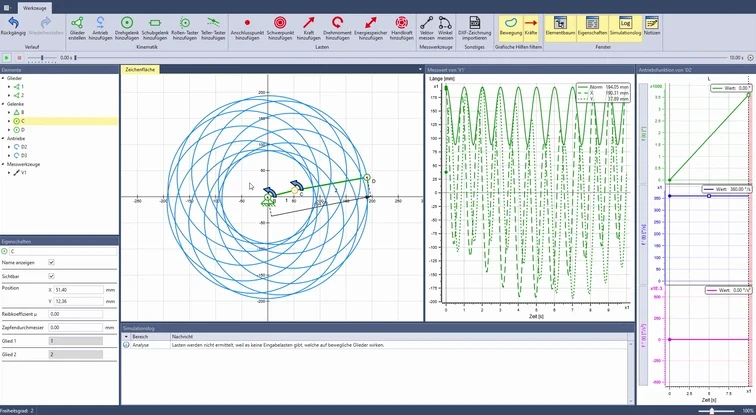
Two links, two drives and the trajectory of one point: the video shows how ASOMmini immediately calculates and displays every change to the model.
 2:39
A dyad consists of two links connected by a joint. Here, the first link is mounted on the frame, and each link has its own rotary drive. The dyad therefore has two degrees of freedom, and the trajectory of its end point depends on both drives. How does it change when a link length or the angular velocity of a drive changes?
You change the model and see the effect on the trajectory and measured values at the same moment. This lets you compare variants in a short time.
Every change appears immediately in the trajectory and diagram, without you having to start a calculation. More on modeling and motion
You measure distances and angles between any points on the model and track them over the entire motion. More on analysis
Instead of calculating variants one by one, you try them out directly on the model.
2:29
A rotating motion becomes an oscillating motion. You shape the motion profile directly in the diagram, segment by segment.
 3:05
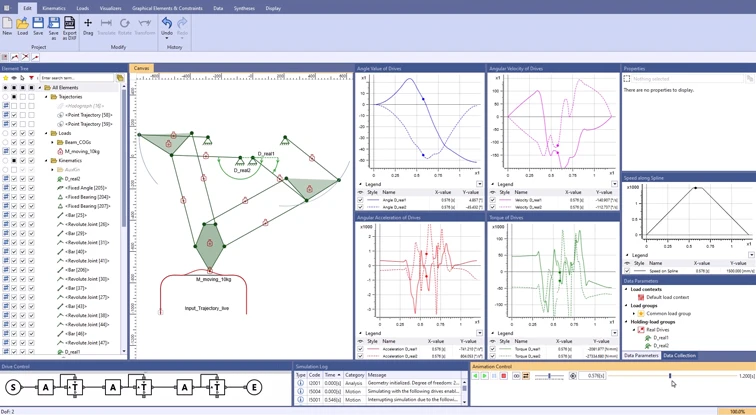
A parallel mechanism with two degrees of freedom: you specify the trajectory, and ASOM provides the angle, speed and torque of the drives, including inertia effects.
 0:42
Three linear drives, one per degree of freedom, move the boom, stick and bucket. In ASOMmini, you coordinate their motion profiles and track the path of the bucket.
Describe your mechanism to us. In an online demo, we will show you ASOMmini using your example.