
 0:42
Excavator arm
Three linear drives, one per degree of freedom, move the boom, stick and bucket. Their motion profiles are coordinated with one another.
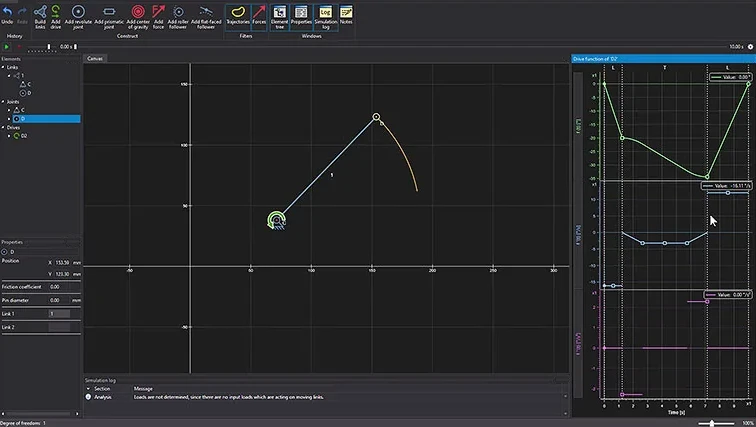
A one-bar linkage should not rotate fully but move as a rocker. The example shows how to define the motion of the link for this in ASOMmini.
 2:29
A one-bar linkage consists of a single link that is mounted on the frame and driven. In the example, it initially rotates at a constant speed. However, it is supposed to move as a rocker. What matters is not only the angle but also how the link accelerates and decelerates.
You see angle, velocity and acceleration side by side and define early on how a drive should move.
You shape the motion on the graph instead of calculating it by hand, segment by segment. More on modeling and motion
You fine-tune how the link accelerates and decelerates, not just its angle.
You try out profiles directly and immediately see which one fits.
0:42
Three linear drives, one per degree of freedom, move the boom, stick and bucket. Their motion profiles are coordinated with one another.
 3:05
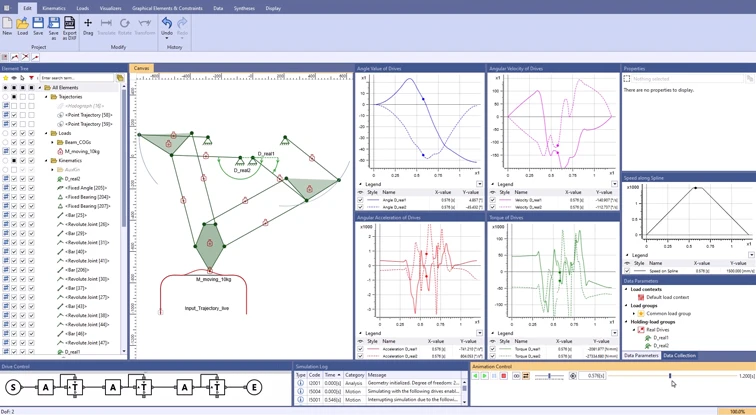
A parallel mechanism with two degrees of freedom: you specify the trajectory, and ASOMv10 provides the angle, speed and torque of the drives, including inertia effects.
 3:35
From a blank sheet to a fully rotating four-bar linkage with bearing forces and friction – the whole process in ASOMmini.
Describe your mechanism to us. In an online demo, we will show you ASOMmini using your example.