
 0:42
Excavator arm
Three linear drives, one per degree of freedom, move the boom, stick and bucket. Their motion profiles are coordinated with one another.
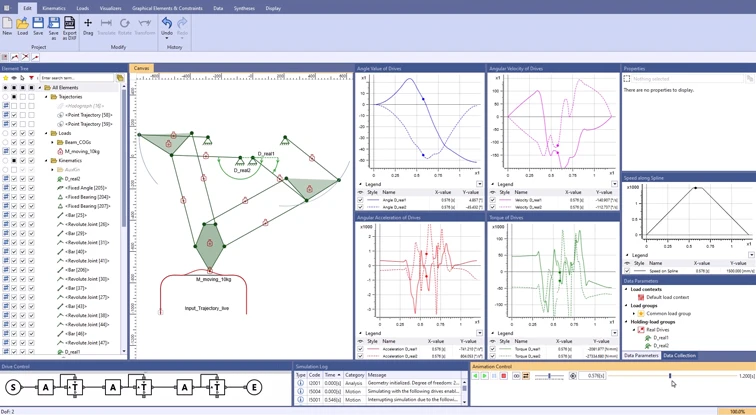
A parallel pick-and-place mechanism is to follow a specified path. From this, ASOMv10 calculates the angle, speed and torque of both drives.
 3:05
The example examines a generic planar parallel pick-and-place mechanism with two degrees of freedom. The trajectory and the velocity profile with which it is traversed are specified. The task is to find the curves at the real drives, all the way to the required torque.
You change the trajectory or joint positions and immediately see which angles, speeds and torques the drives have to deliver for it.
Trajectory as input, drive values as output: this is how ASOMv10 also solves inverse kinematics tasks in most cases.
You define yourself in the drive control how the point accelerates, travels and decelerates. More on motion sequences
You try out new positions directly, and the model stays consistent. More on constraints
0:42
Three linear drives, one per degree of freedom, move the boom, stick and bucket. Their motion profiles are coordinated with one another.
 3:03
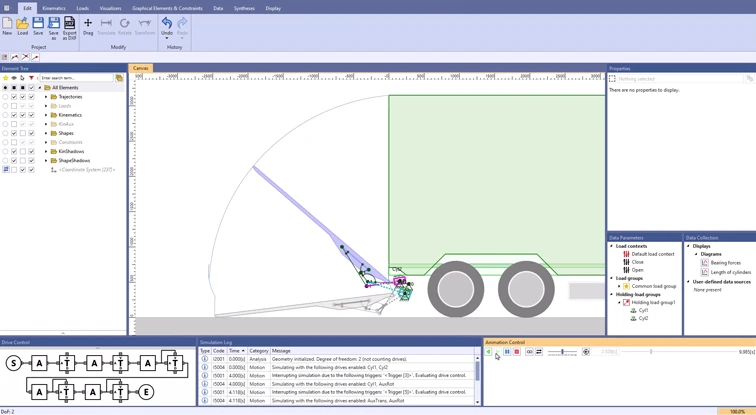
Two hydraulic cylinders open the gate and raise and lower the platform. ASOMv10 combines the partial movements into one motion sequence and calculates the bearing forces with friction.
 1:32
At 6,000 rpm, inertia matters. ASOMv10 calculates the joint and bearing forces with connecting rod, counterweight and piston.
Describe your mechanism to us. In an online demo, we will show you ASOMv10 using your example.