
 3:35
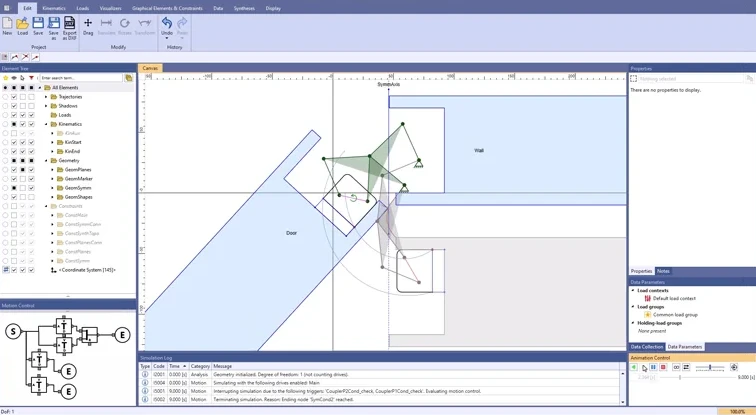
Symmetrical six-bar linkage for a door
A six-bar linkage guides a door, with the joints arranged symmetrically. The synthesis is built from constraints alone, and the start and end positions remain adjustable.
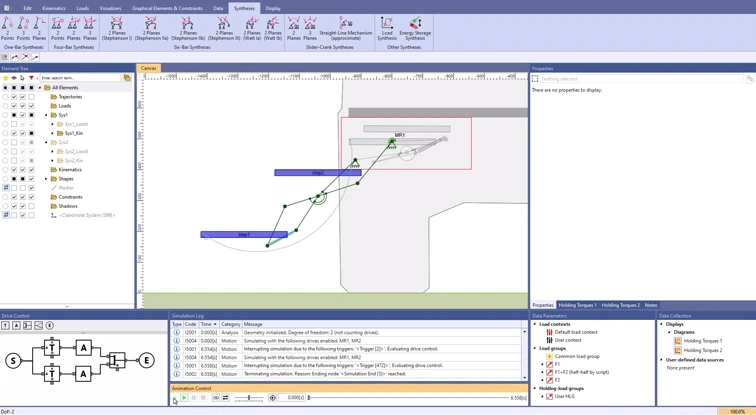
Scissor kinematics or parallelogram linkage? For the fold-out, two-step ladder of a motorhome, ASOMv10 compares both mechanisms in one project.
 4:43
The first variant is a six-bar linkage with scissor kinematics, the second a parallelogram linkage – which can also be understood as a special case of the same six-bar linkage type. For both variants, a suitable solution and the required torques are to be found. In addition, there are forces that depend on whether the steps are retracted or extended.
You compare both mechanisms in one project and see early on which torque each variant requires.
The synthesis provides suitable linkages, so you do not have to try out joint positions by hand. More on syntheses
Both variants stay in the same project, and you compare every change directly.
With scripts, you capture your own rules, such as forces that depend on the position of the steps. More on scripts
3:35
A six-bar linkage guides a door, with the joints arranged symmetrically. The synthesis is built from constraints alone, and the start and end positions remain adjustable.
 5:01
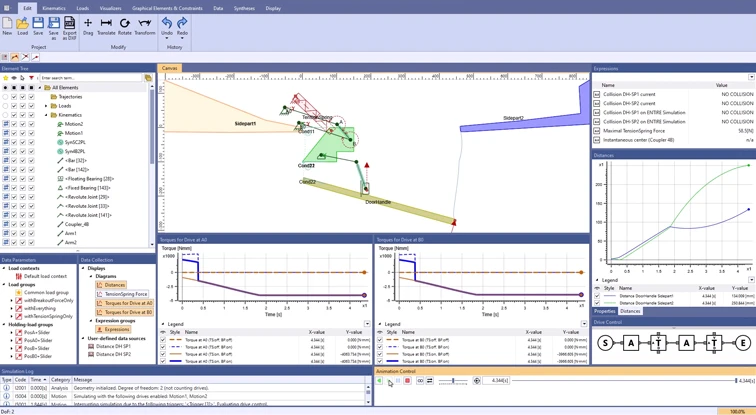
A retractable handle with three specified positions. Two syntheses hold them in place while you move bearings, and ASOMv10 calculates eight drive cases at once.
 3:03
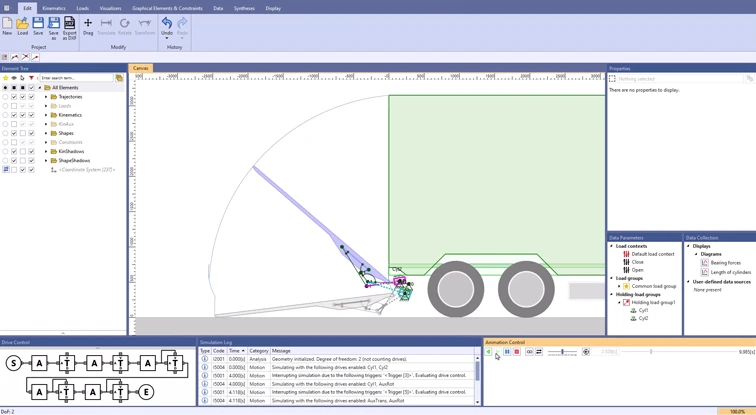
Two hydraulic cylinders open the gate and raise and lower the platform. ASOMv10 combines the partial movements into one motion sequence and calculates the bearing forces with friction.
Describe your mechanism to us. In an online demo, we will show you ASOMv10 using your example.