
 1:40
Motor-driven car seat
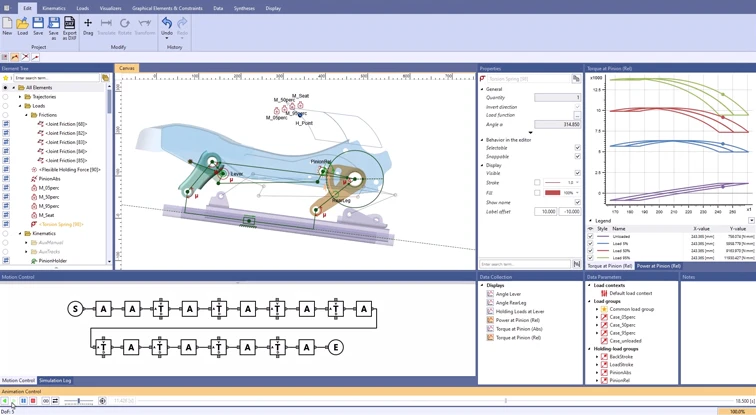
An electric motor moves the seat to all extreme positions. ASOMv10 shows torque and power for different seat occupancies – and immediately what difference a torsion spring makes.
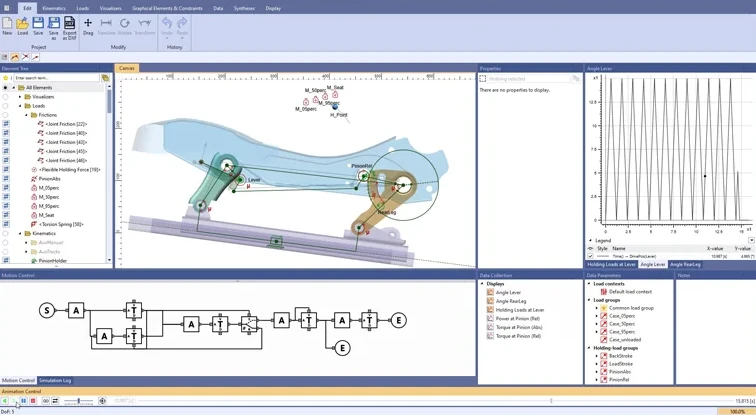
A hand lever adjusts the car seat stroke by stroke. ASOMv10 plays back the lever strokes automatically and shows the manual force for different seat occupancies in one diagram.
 2:29
The mechanism consists of a four-bar linkage that a hand lever drives via a gear pair. Because the lever has only a limited angular range, it takes several strokes for the rear rocker to reach its end angle – each with a load stroke and a return stroke. How much manual force is required also depends on the seat occupancy.
Instead of recalculating individual strokes, you see the entire adjustment process at once.
You assemble loops and conditions from blocks; even long adjustment processes run by themselves. More on motion sequences
You see immediately whether the manual force remains comfortable for light and heavy occupants alike. More on force calculation
Change the lever or the gear ratio, and all four curves change immediately.
1:40
An electric motor moves the seat to all extreme positions. ASOMv10 shows torque and power for different seat occupancies – and immediately what difference a torsion spring makes.
 2:10
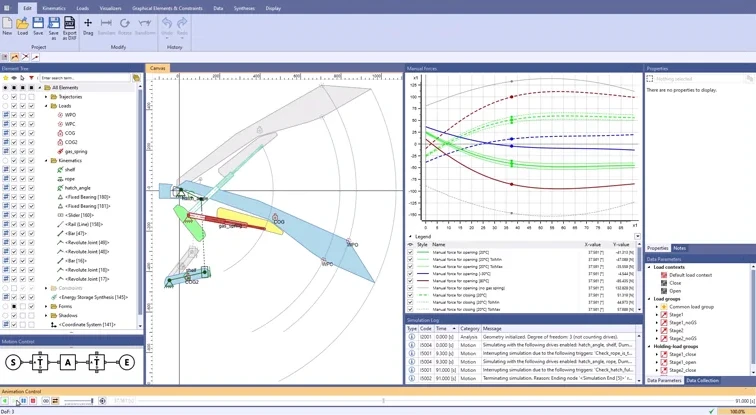
Two gas springs whose force depends on temperature and direction, plus a parcel shelf on a cord. ASOMv10 shows all manual forces for opening and closing in one diagram.
 2:31
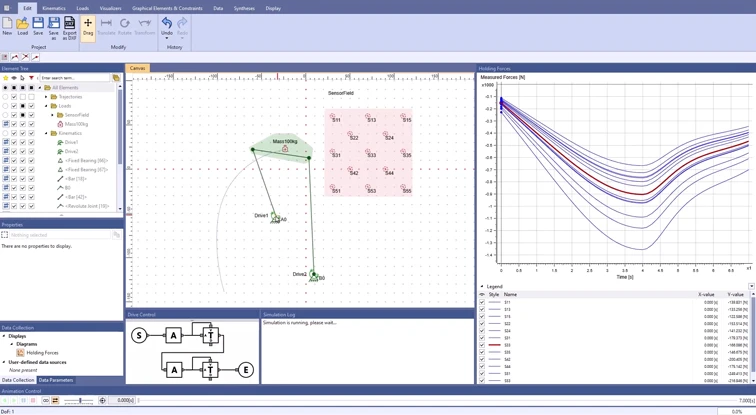
Where should the hand apply force? ASOMv10 shows the manual force for many application points at once in one diagram – even while you move the points.
Describe your mechanism to us. In an online demo, we will show you ASOMv10 using your example.