
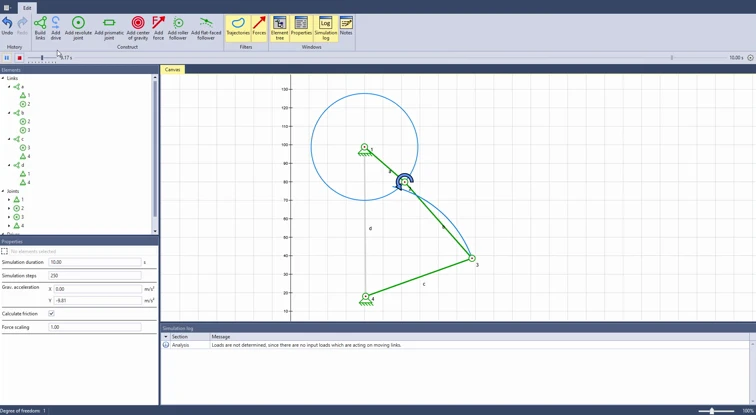
 1:17
Crank-rocker
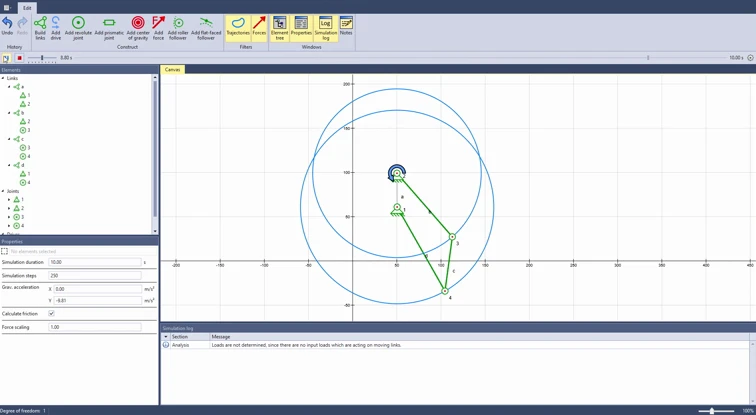
Four-bar linkage series, part 1: the crank turns fully while the rocker swings. The Grashof condition and the choice of frame tell you when this is the case.
If links of equal length are next to each other, the frame decides: isosceles double-crank or isosceles crank-rocker. If all links are of equal length, the result is the rhombus linkage.
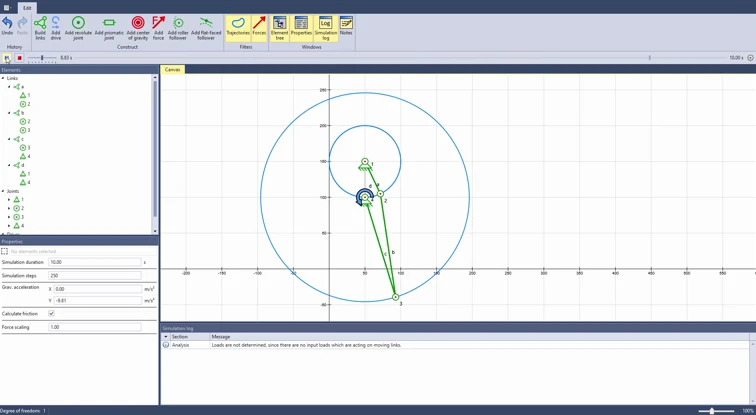 1:11
These linkages meet the Grashof condition as an equation, just like the parallelogram and antiparallelogram linkages, and they too have change points at which they can flip. Here, however, the links of equal length are next to each other.
If a short link is the frame, both neighbors turn fully: the isosceles double-crank. If a long link is the frame, the short link pivoted on the frame becomes a crank and the long one a rocker: the isosceles crank-rocker. Both are used only in special cases because, unlike their namesakes, they can flip.
If all links are of equal length, not only the links but also the joints lie on top of each other in pairs at the change points. Even small manufacturing deviations can then noticeably change the motion, forces and torques – something to keep in mind when simulating.
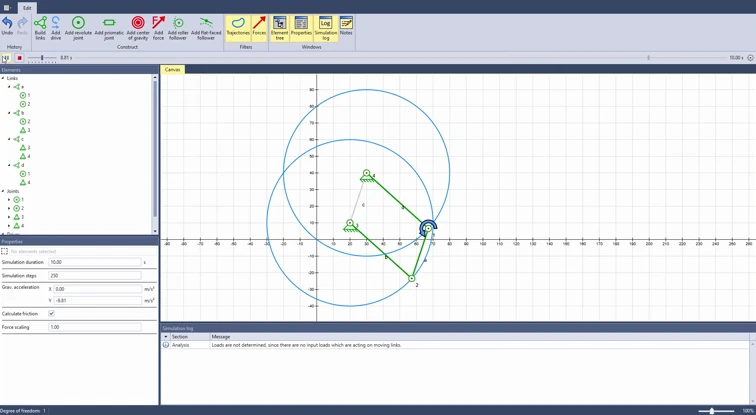
1:11a = d = 50, b = c = 146, so a + b = 196 = c + d. Both neighbors of the frame turn fully.
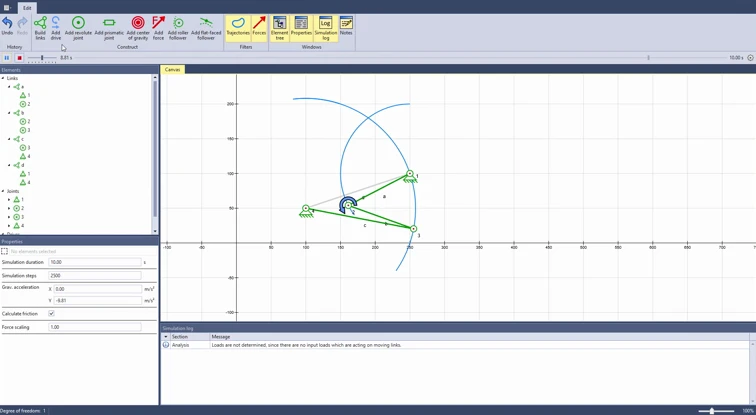 1:24
a = b = 100, c = d = 158, so a + c = 258 = b + d. The short link turns fully as a crank, while the long one swings as a rocker.
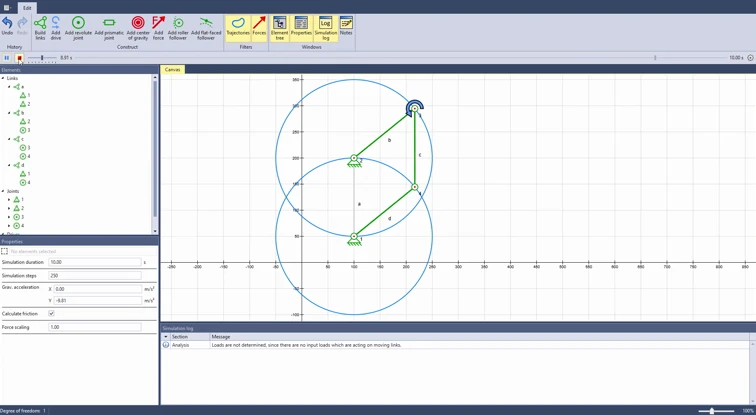 0:59
a = b = c = d = 150, so a + b = 300 = c + d. Also called a rhombus crank.
In ASOMmini, you build every type in this series with just a few clicks and immediately see how it moves.
Move a joint, and ASOMmini recalculates the motion in real time – so you can see when a link no longer turns fully.
Trajectories show the paths of the joints, and diagrams show angles, velocities and accelerations over the entire motion sequence. More on analysis
With masses, springs and friction, the basic type becomes a concept – and ASOMmini calculates its forces and torques. More on force calculation
1:17
Four-bar linkage series, part 1: the crank turns fully while the rocker swings. The Grashof condition and the choice of frame tell you when this is the case.
 1:22
Four-bar linkage series, part 2: if the shortest link is the frame, both links pivoted on the frame turn fully.
 1:01
Four-bar linkage series, part 4: links of equal length are opposite each other, as a parallelogram or crossed – a limit case of the Grashof condition.
Describe your mechanism to us. In an online demo, we will show you ASOMmini using your example.